Featured pick for this guide.
As an Amazon Associate we earn from qualifying purchases.
Grimdark miniatures — grim, gothic, battle-worn heroes and monsters from settings like Warhammer 40,000 and Age of Sigmar — live or die on their paint jobs. A “grimdark” aesthetic isn’t just about slapping on dark colors; it’s built from layered shadows, rusted metals, blood spatter, and weathered edges that make a model look like it survived a war. Getting there reliably means starting with a paint set that actually gives you the right tonal range (deep reds, bone, gunmetal, black-green) plus the brushes and tools to apply it cleanly, rather than a generic hobby paint pack with the wrong palette entirely.
What is the best Grimdark Paint Set for beginners?
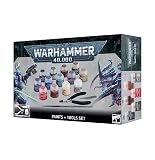
For anyone starting out, the Games Workshop – Warhammer 40,000: Paints + Tools Set ($38.25) is the most sensible entry point. It’s produced by the studio behind the grimdark aesthetic itself, so the paint selection is already tuned to the look — deep base colors, metallics for battle damage, and shades for building up that oppressive, war-torn depth rather than flat, cartoonish color. Because it bundles brushes and basic tools alongside the paints, a beginner doesn’t need to guess at a separate brush purchase or piece together a palette from unrelated lines. It’s a genuinely practical one-box starting point rather than a “starter kit” in name only.
Frequently Asked Questions about Grimdark Paint Set
Is matt or satin varnish better for miniatures?
For grimdark miniatures, matt varnish is almost always the better call. Satin and gloss finishes reflect light in a way that flattens out the subtle shading grimdark painting relies on — the whole point is muted, oppressive depth, and a shiny surface fights against that illusion. Matt varnish also better disguises brushstrokes and blending transitions on cloaks, armor, and rusted metal, which is exactly where grimdark technique does its heaviest lifting. Satin has its uses on wet-look surfaces like blood or slime, but as a full-model topcoat, matt is the standard choice.
What can I use as an alternative to Nuln Oil?
Nuln Oil is a black-toned wash prized for the deep, sooty recesses it creates, which is a big part of the grimdark look. If you don’t have it on hand, any black or near-black wash with a similar thin, ink-like consistency will do a comparable job — the key is a wash that pools in crevices and panel lines without leaving a visible sheen once dry. A homemade mix of black ink or acrylic paint heavily diluted with water and a drop of flow improver can approximate it in a pinch, though dedicated hobby washes give more predictable, even results across a whole army.
What is the best magnification for painting miniatures?
Most miniature painters find a 3x to 5x magnification comfortable for everyday detail work like eyes, insignia, and fine weathering, with higher magnification reserved for very small elements. A magnifier genuinely helps with grimdark techniques specifically, since layered glazes, sponge-applied chipping, and fine blood spatter all rely on seeing exactly where pigment lands — mistakes are far easier to catch early under magnification than after the varnish is sealed.