The story behind Critical Role's breakout tabletop RPG — where it came from, how it relates to D&D, and why it took off as fast as it did.
The Story Behind Daggerheart
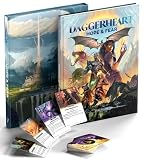
Daggerheart is a fantasy tabletop role-playing game published by Darrington Press, the publishing arm founded by the cast of Critical Role. Lead designer Spenser Starke built the game with a small internal design team, and the core rulebook launched in May 2025 after an extended public playtest period — Darrington Press had been iterating on the system with community feedback well before the full release.
It didn't launch quietly. The core set sold out within two weeks of release, and Darrington Press followed that with a distribution deal with Macmillan to get Daggerheart onto general bookstore shelves — not just the hobby and game stores that usually carry tabletop RPGs. That's a real signal of intent: publishers don't pursue mainstream retail distribution for a product they expect to stay niche.
Daggerheart vs. D&D — The Family Tree
Daggerheart isn't a clean break from Dungeons & Dragons — it's built on a modified version of the 5e System Reference Document, the open-license ruleset D&D 5th Edition is partly built from. That shared foundation is exactly why comparisons to D&D are so common: familiar bones, a genuinely different game sitting on top of them.
The Dice: Duality vs. the d20
D&D resolves almost everything with a single d20 against a target number. Daggerheart replaces that with Duality Dice — two twelve-sided dice rolled together, one representing Hope and one representing Fear. Whichever die comes up higher doesn't just determine success or failure; it determines who gets a resource out of the roll.
Hope and Fear: A Resource System D&D Doesn't Have
That's the mechanic the game is named for. Roll higher on the Hope die, and your character banks Hope — a currency spent later for narrative and mechanical advantages. Roll higher on the Fear die, and the GM banks Fear, which they spend to introduce complications, escalate threats, or twist the scene. D&D has nothing structurally equivalent — the DM improvises complications; in Daggerheart, complications are paid for with an accumulated, visible resource, on both sides of the table.
No Traditional Initiative Order
D&D runs combat in a fixed turn order rolled once per encounter. Daggerheart drops that entirely in favor of a more fluid, spotlight-based flow, where narrative momentum and Fear/Hope spends influence who acts next rather than a locked initiative roll.
A Different Job for the GM
Because Fear functions as a real, trackable GM resource rather than an abstraction, running Daggerheart asks something different of a Game Master than running D&D does — less about adjudicating a fixed ruleset, more about managing a resource economy that's shared, visibly, with the players.
Why Daggerheart Took Off
A Built-In Audience From Day One
Critical Role's audience is one of the largest in tabletop gaming, built over a decade of actual-play streaming. A game published by the cast's own company started with a real, pre-existing audience most new TTRPGs spend years trying to build.
It Sold Out Before Most Games Get Reviewed
The core set sold out within two weeks of its May 2025 release — before most new tabletop games have even accumulated their first wave of reviews.
A Deal That Signals Mainstream Reach
The Macmillan bookstore distribution deal matters beyond the sales figure itself — it's a bet from a major publisher that demand extends past the existing hobbyist base and into general retail. That's a different kind of validation than hobby-store sell-through alone.
The Design Philosophy People Actually Wanted
Daggerheart is explicitly built to be narrative-first and lighter on rules-crunch than D&D 5e — a design lane a meaningful slice of the TTRPG audience has been asking for, without abandoning the class-and-fantasy structure that makes a system immediately legible to anyone who's played D&D before.
The Expansion Landscape — Hope & Fear and What's Next
What's In Hope & Fear
Daggerheart's first major expansion, Hope & Fear, digitally releases on Demiplane on August 25, 2026, with physical accessories — a GM screen, Fear tracker, and adversary deck — following later. It adds four new classes (Witch, Warlock, Brawler, and Assassin), each with two subclasses, tied to a new Dread Domain. It also introduces a Transformation mechanic, along with 130+ new adversaries, 28 new environments, and four new campaign frames for GMs to build from. One class that had been in public playtesting, the Blood Hunter, is notably not part of this release.
Where to Start with Daggerheart
If you haven't played Daggerheart yet, the core rulebook is the starting point — Hope & Fear is an expansion built on top of that foundation, not a replacement for it. Once your table has the core system down, Hope & Fear is the natural next purchase: four new classes and a new domain give an existing group real reasons to come back to character creation, without requiring a new group to learn a second system first.
New to tabletop RPGs entirely rather than just new to Daggerheart? See what you actually need to start playing a TTRPG before picking a system.
FAQ
Daggerheart is a fantasy tabletop role-playing game from Darrington Press, the publishing company founded by the cast of Critical Role. It launched in May 2025 and uses a Duality Dice system built around Hope and Fear as paired resources for players and the GM.
It's built on a modified version of the D&D 5th Edition System Reference Document, but its core resolution system (Duality Dice, the Hope/Fear economy, and its approach to initiative) is structurally different from D&D.
Spenser Starke led design for Daggerheart at Darrington Press, developed with an internal team and an extended public playtest before the May 2025 release.
Yes. Hope & Fear is an expansion — new classes, a new domain, new adversaries and environments — built on top of the core rulebook, not a standalone replacement for it.